
July 26, 2026
Alert Fatigue Is Breaking NOC Workflows: Correlation, Suppression, and Trust Rebuilding in 2026
Why NOC teams still drown in alerts that do not need human action, and how correlation, root-cause suppression, and inspectable automation rebuild trust in incident workflows.
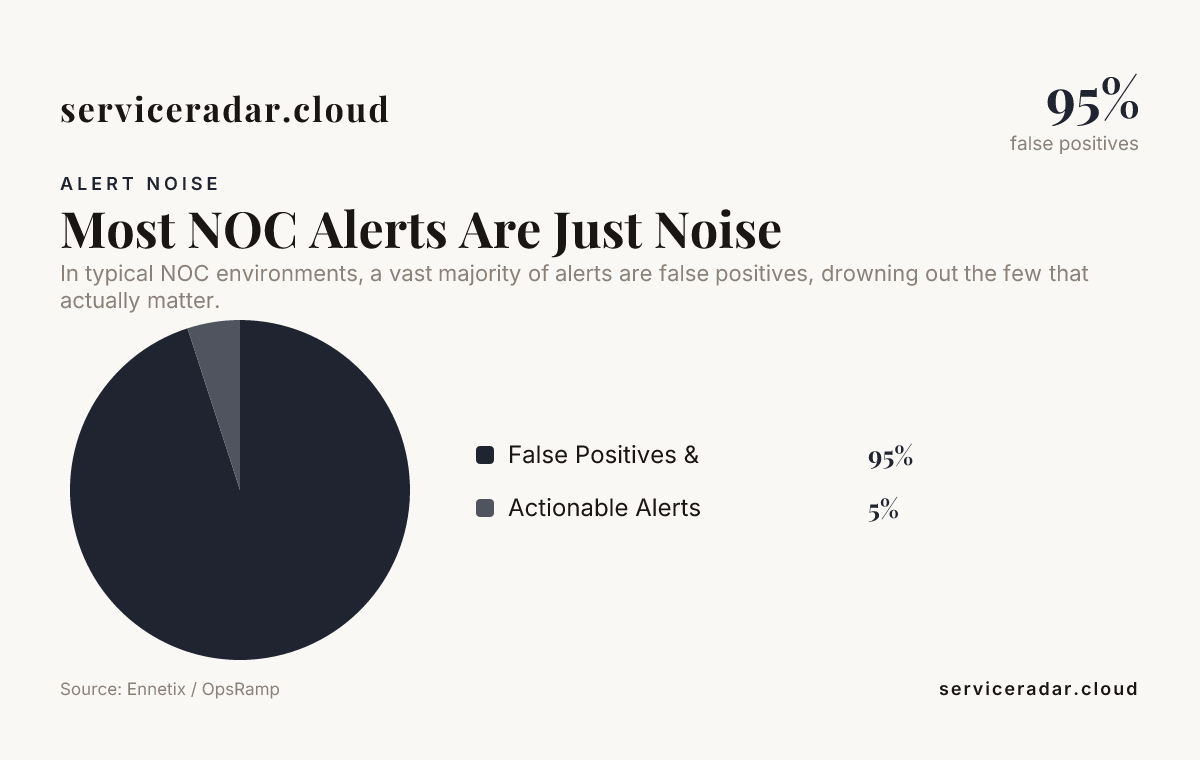
Fewer than 5% of the alerts a typical NOC team receives each day actually require a human to do anything about them, and yet those teams are still fielding 10,000 or more alerts in a single 24-hour window. That math is the reason alert fatigue is breaking NOC workflows across the industry in 2026, and it is why correlation, suppression, and trust rebuilding have become the three words every ops leader keeps repeating in postmortems.
Key takeaways
- Alert fatigue in 2026 is a volume problem first, a tooling problem second. Most NOC and SOC teams still triage alerts one at a time instead of as correlated incidents.
- Suppression without context creates blind spots. Muting noisy alerts without root-cause correlation is how real outages get missed.
- Trust rebuilding is now a distinct engineering discipline. Engineers will not act on automated triage until they can see why an alert fired.
- Open, inspectable platforms win over black-box AIOps. Teams want to see the correlation logic, not just trust a score.
- Incident management process maturity matters more than the tool brand. ITIL-aligned incident, problem, and major-incident workflows all depend on clean signal.
- SIEM and ITSM tools need to talk to each other. Security event data and incident management platforms are converging, not staying siloed.
- Edge discovery reduces noise at the source. Knowing what is actually on the network before it starts alerting cuts a large share of false positives before they reach a human.
Why alert fatigue is breaking NOC workflows in 2026
Every NOC we have talked to this year describes the same failure mode. A device flaps, a threshold trips, and within minutes a single root cause has fanned out into forty, fifty, sometimes a hundred individual alerts.
None of those alerts know they are siblings. Each one lands in the queue as if it is the only thing happening on the network, and the engineer on shift has to reconstruct the relationship by hand, under pressure, at 3 a.m.
This is the core reason alert fatigue is breaking NOC workflows industry-wide right now. It is not that teams lack monitoring coverage. It is that monitoring coverage without correlation just produces more raw material for burnout.
Ennetix research on NOC and SOC teams found organizations typically see an 80 to 95 percent reduction in alert volume within the first 90 days of deploying real correlation, which tells you how much of that “coverage” was actually just noise wearing a disguise.
The real cost of alert fatigue: downtime, trust, and turnover
The dollars are the easiest part to quantify. Unplanned downtime averages $5,600 per minute according to DevOps.com analysis of AI-powered observability adoption, and that clock starts running the moment a signal that should have triggered action gets buried under forty duplicates.
But the cost is not only financial. Vectra AI research on security alert fatigue found 42 percent of security alerts go entirely uninvestigated by teams that are simply too stretched to look at everything. That is not a staffing problem you solve by hiring more analysts. It is a signal-to-noise problem you solve by fixing what reaches the analyst in the first place.
The human cost compounds from there. Nearly 83 percent of engineers admit to ignoring or dismissing alerts at least occasionally, not out of negligence, but as a survival mechanism against a queue that never stops.
Correlation is the fix, not more dashboards
The instinct when alert volume climbs is usually to build another dashboard. That is backwards. A dashboard shows you more of the same noise, just prettier. What actually breaks the cycle is correlation logic that groups related alerts into a single incident before a human ever sees them.
This is where query languages matter more than most teams realize. SRQL, ServiceRadar’s query layer, lets an engineer ask questions about related devices, topology, and recent state changes instead of scrolling through a flat alert list hoping to spot the pattern manually.
That is the difference between an incident management process built around volume and one built around relationships. The Dashboard SDK exists so teams can build views around those relationships instead of around raw event streams.
Suppression without blind spots
Suppression gets a bad reputation, and it earns most of it. Blanket suppression rules, the kind written in a panic after a bad on-call week, are how real incidents get muted along with the noise.
NeuBird research backs this up directly: 78 percent of organizations have experienced incidents where no alert fired at all, forcing the customer to discover the failure first. That is suppression gone wrong, not suppression working as intended.
The fix is not less suppression. It is suppression that is tied to root cause instead of applied blindly at the source. If an edge gateway goes offline and takes forty downstream devices with it, you want one incident with forty linked children, not forty independent pages competing for the same engineer’s attention.
That requires knowing the topology before the alert fires, which is exactly why discovery and inventory sit upstream of correlation in a properly designed monitoring stack.
Trust rebuilding: why engineers do not believe the automation yet
Here is the uncomfortable part of the trust rebuilding conversation. NeuBird’s 2026 survey found 74 percent of executives believe AI is actively being used to resolve incident management problems at their organization, while only 39 percent of engineers agree.
That gap is the entire trust rebuilding problem in one statistic. Leadership bought the tool. The people on call at 3 a.m. still do not trust it enough to let it act unsupervised, and honestly, they should not have to trust a black box.
The same principle that applies to capability-based plugin security applies here: an admin should be able to see exactly what a component is allowed to touch before granting it access, not take a vendor’s word for it. Correlation and suppression need the same transparency. An engineer needs to see why the system grouped these forty alerts together, not just receive a summary that says “resolved by automation.”
Where SIEM, ITSM, and incident management software meet the noise problem
Alert fatigue does not respect the boundary between security and operations. A security event management system flags something suspicious, and thirty seconds later the NOC’s own monitoring stack fires a completely unrelated-looking alert on the same host. Nobody connects the two, because SIEM and ITSM live in different tools with different owners.
Whether your team runs incident management in ServiceNow, leans on Datadog for observability-driven alerts, or routes pages through PagerDuty, the underlying requirement is the same: a shared source of truth about what is actually happening on the network. Major incident workflows fall apart fastest when the SIEM’s version of events and the ITSM’s version of events disagree about timeline and root cause.
ITIL incident management and problem management were built for a world with dozens of alerts a day, not thousands. Problem management in particular, the discipline of asking why this keeps happening instead of just closing the ticket, gets skipped entirely when teams are drowning. That is the quiet tragedy of alert fatigue: it does not just burn out the people doing incident response, it actively prevents the root-cause analysis that would reduce future incident volume.
Why we built correlation around an open, inspectable platform
We built ServiceRadar around a simple premise: you cannot rebuild trust in automated triage if the automation is a black box. Every correlation decision, every suppression rule, every piece of discovery data needs to be something an engineer can actually inspect, not just accept.
That starts with knowing what is on the network before anything alerts. Our edge observability approach discovers infrastructure from the edge inward, so correlation has real topology to work with instead of guessing at relationships after the fact.
We also believe tool sprawl is part of the alert fatigue problem, not a separate issue. When your SIEM, network monitor, ITSM, and custom scripts all fire independently, nobody owns the correlation, so nobody trusts the result. Consolidating that sprawl into a single, open and inspectable architecture is how we approach the problem.
If you would rather see it running before committing to anything, the live demo environment is open for exactly that reason.
Extending correlation logic without losing trust
One thing we learned early: teams do not want a monitoring platform that only correlates the things we anticipated. They want to extend it with their own logic for their own specific infrastructure.
That is where plugins and add-ons come in. But extensibility without safety just recreates the trust problem at a different layer, so every plugin runs in a sandboxed, capability-based model where access has to be explicitly granted, not assumed.
Developers can start in the developer portal or the broader documentation hub. Nothing here is hidden behind a black box, and that is deliberate.
Building an incident management process that survives 2026 alert volumes
If your incident management process still treats every alert as an individual ticket, it was designed for a network that no longer exists. Modern infrastructure generates too much telemetry for a flat queue to work. Here is the shift teams need to make in 2026:
- Correlate before you triage. Group related alerts by topology and timing before a human ever sees them individually.
- Suppress by root cause, not by symptom. Mute the children of a known incident, never the parent signal itself.
- Make the reasoning visible. Engineers need to see why alerts were grouped or suppressed, not just trust a summary.
- Keep problem management funded. Root-cause elimination is the only long-term fix for alert volume.
- Unify SIEM and ITSM data. Security and operations alerts about the same host need to reach the same incident.
Research on agentic AI in NOC environments found that a complex alert storm which takes a human engineer roughly 58 minutes to correlate and triage can be handled by well-built automation in about 90 seconds. That gap is the business case for fixing correlation, and it is also why so much engineer time still goes toward firefighting instead of the proactive work that would prevent the fires in the first place.
Conclusion
Alert fatigue is breaking NOC workflows in 2026 not because teams lack tools, but because most tools were never designed to correlate, suppress intelligently, or explain their own reasoning. The fix is not fewer alerts for the sake of fewer alerts.
It is correlation that groups signal correctly, suppression that is tied to root cause instead of blanket rules, and trust rebuilding that comes from showing engineers the reasoning behind every decision instead of asking them to take it on faith. Get those three right, and the incident management process stops being a source of burnout and starts being a source of actual reliability.
Frequently asked questions
What exactly is alert fatigue in a NOC or SOC context?
Alert fatigue happens when engineers receive so many alerts, most of them false positives or duplicates, that they start ignoring or dismissing signals, including the small percentage that actually matter. In 2026, teams commonly report over 10,000 alerts a day with fewer than 5% requiring real action.
How does alert correlation reduce alert fatigue?
Correlation groups related alerts from a single root cause into one incident instead of presenting them as dozens of separate events. Organizations deploying real correlation typically see an 80 to 95 percent drop in alert volume within 90 days.
Is suppressing alerts a good practice for incident management?
Suppression only works when it is tied to a known root cause. Blanket suppression rules are a leading reason organizations miss real incidents entirely. 78% of organizations report experiencing incidents where no alert fired at all, often because suppression rules were too broad.
Why do not engineers trust AI-driven incident management yet?
Engineers distrust automated triage mainly because they cannot see the reasoning behind its decisions, which is why 74% of executives believe AI is resolving incidents effectively while only 39% of engineers agree. Trust rebuilding requires transparent, inspectable correlation logic rather than a black-box score.
What is the difference between incident management and problem management?
Incident management focuses on restoring service quickly after something breaks, while problem management investigates why incidents keep recurring so the root cause gets fixed permanently. Teams overwhelmed by alert fatigue often skip problem management entirely, which guarantees the same alerts keep coming back.
Can platforms like ServiceNow, Datadog, or PagerDuty solve alert fatigue on their own?
These tools handle routing, ticketing, and paging well, but alert fatigue is primarily a correlation and discovery problem that sits upstream of any single ITSM or observability platform. Pairing incident management software with a discovery-first, correlation-focused monitoring layer closes that gap more effectively than any single tool alone.
Is fixing alert fatigue worth the investment in 2026?
Yes. Unplanned downtime averages $5,600 per minute, and 44% of organizations have already experienced a major outage directly caused by suppressed or ignored alerts, making correlation and trust rebuilding one of the highest-return fixes a NOC can make this year.
Next step
Ready to rebuild signal quality in the NOC?
Talk through correlation, discovery, and inspectable automation with our technical sales team, or try the public demo while Cloud signup is still coming soon.