Skip to content

ServiceRadar

Open navigation

Open-source network operations

Monitor, map, and secure every site from one open platform.

Discovery, telemetry, flow analytics, threat intelligence, and cameras in one place. Agents keep collecting when the link drops.

Demo login demo@serviceradar.cloud serviceradar

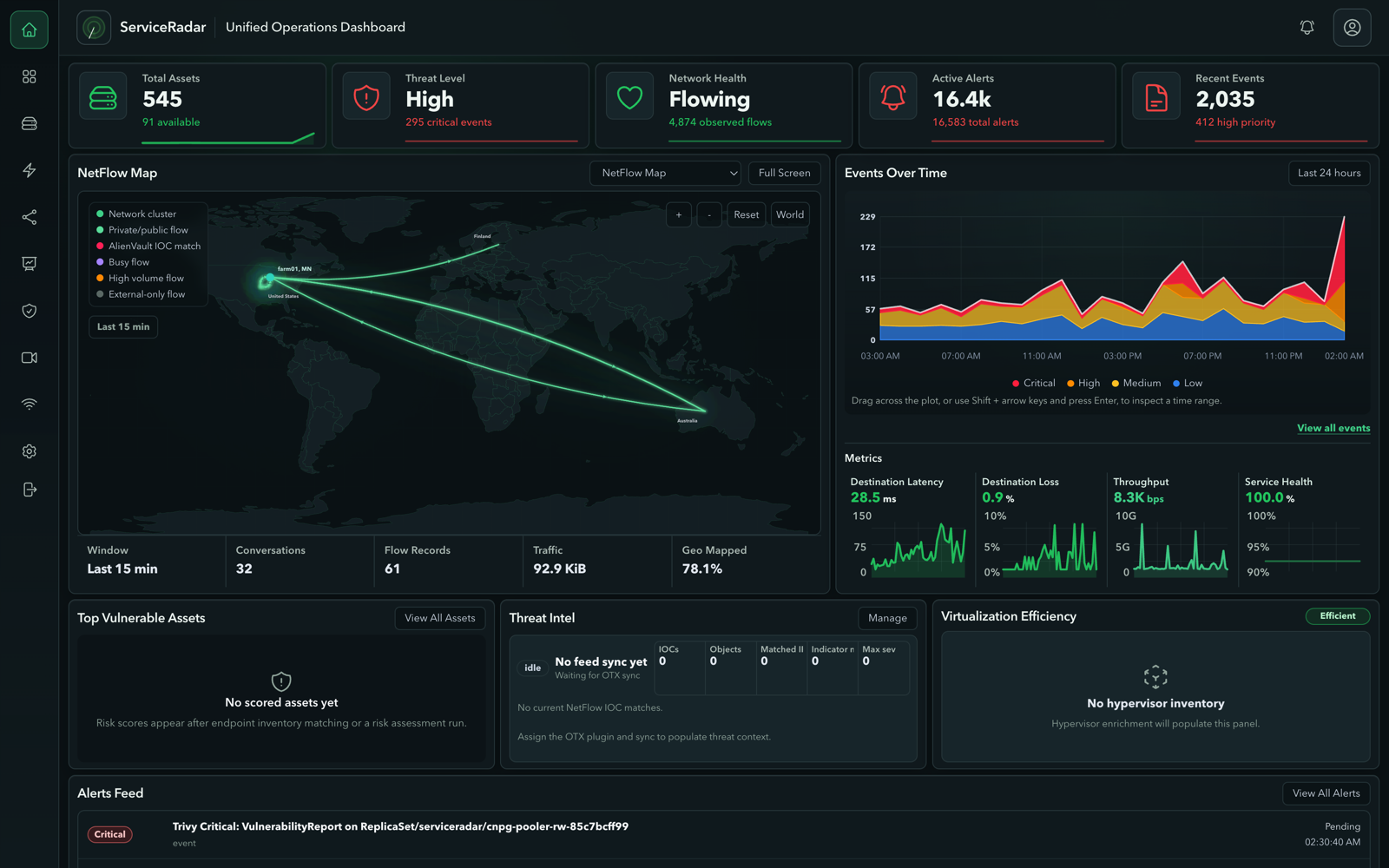
ServiceRadar unified operations dashboard with a NetFlow map, events over time, threat intel, and alerts
Unified operations dashboard

One platform instead of five consoles

Most teams run separate products for discovery, monitoring, flow analysis, security posture, and cameras, then reconcile them by hand. ServiceRadar puts those jobs on one inventory, one query language, and one agent.

  • Discovery and inventory

    Agents and edge collectors keep a living inventory of devices, interfaces, services, and installed software from SNMP, LLDP, CDP, Proxmox, UniFi, and more.

  • Monitoring and observability

    ICMP and TCP checks from multiple vantage points, plus OTLP, syslog, GELF, SNMP traps, BMP, and NetFlow, sFlow, and IPFIX intake.

  • Flow analytics

    Attribute conversations to processes, containers, and Kubernetes workloads. Map public VIPs to Services. Enrich with ASN, GeoIP, prefix tags, and threat feeds.

  • Security posture

    Falco and Trivy findings, DNS RPZ hits, and vulnerability matches land as OCSF events next to the devices they belong to.

  • Cameras and field work

    Any IP camera, with first-party plugins for UniFi Protect, Axis, and generic RTSP. Inventory, events, and live view sit next to the network the cameras run on, and WiFi survey workflows stay attached to site context.

  • One query language

    SRQL spans inventory, telemetry, flows, and security findings. Saved queries drive alerts, dashboards, and which agents run which plugins.

Why teams are switching to ServiceRadar

ServiceRadar Atlas: one map of the whole estate

Atlas draws every device in the inventory on one server-computed map and serves it as tiles. A query like the one below marks the matching devices in place instead of redrawing the map.

(VLAN 20 OR VLAN 30) AND unavailable EXCEPT tag maintenance=true
Devices on one map
1.1M
Query time
~1 ms
Read the engineering post
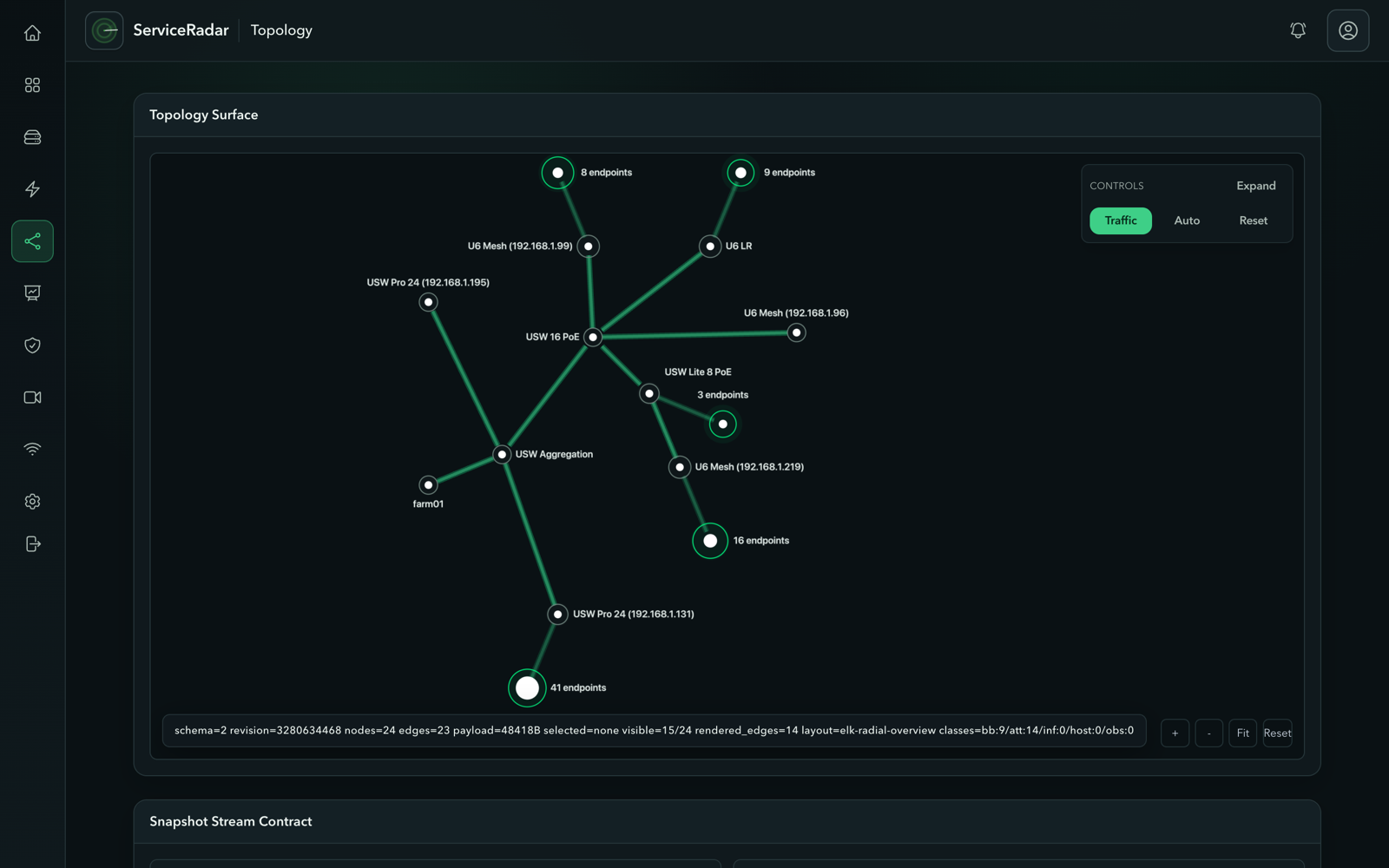
ServiceRadar Atlas topology map

ServiceRadar Horizon: global Internet Intelligence built into ServiceRadar Cloud

See beyond your perimeter. Horizon combines global Internet Weather, live BGP and routing security intelligence, and end-to-end multipath visibility with your private network and real-user telemetry—so you know immediately whether an outage is yours, your ISP’s, or your SaaS provider’s.

Impact-weighted outages beat raw probe alerts every time. Upstream ISP and transit disruptions automatically suppress noisy NOC alerts, shareable snapshots preserve root-cause evidence, and your private telemetry never leaves your ServiceRadar Cloud instance.

Included with
Cloud Enterprise
Also available via
API & MCP
Explore ServiceRadar Horizon
ServiceRadar Horizon correlates global Internet Weather, BGP routing, and multipath visibility with private telemetry inside ServiceRadar Cloud Outside Internet signals Global vantage points Cloud, ISP & branch coverage Global BGP intelligence Hijacks · route leaks · RPKI · IXP Multipath & synthetics Hop-by-hop paths · HTTP/3 · DNS Inside telemetry (stays private) Your ServiceRadar data NetFlow · SNMP · internal BGP Real User Monitoring (RUM) Never leaves your instance Horizon Intel Feed Verified global consensus ServiceRadar Cloud Inside + Outside fusion Included on Enterprise Actionable outcomes Impact-weighted outages NOC noise suppressed · SLOs Shareable root-cause snapshots Paid API & MCP Read-only MCP for SRE agents Signed incident webhooks Live GeoJSON Weather Map

Collection that survives the link going away

Core issues signed schedule leases. Agents keep executing them offline, write every record to disk before anything is acknowledged, and deliver over mTLS into NATS JetStream. An ack means the data is safe, and core can tell a late result from a sweep that never ran.

How durable edge records work
Durable collection path: edge agent, local disk spool, NATS JetStream, then Postgres link down, still collecting Edge agent Signed schedule leases, online or offline Local disk spool Written to disk before anything is acked NATS JetStream Delivered over mTLS gRPC, committed once Postgres and warehouse Projected once, redeliveries detected
Coming soon

Exposure intelligence: from CVE to blast radius

Which devices are exposed to this CVE right now? Which KEV-listed hosts talked to a threat indicator in the last 24 hours? Which vulnerable listening processes took inbound connections from the internet? Exposure joins package inventory, process ownership, host- and network-observed connections, and topology so each of those is one SRQL query, with provenance on every row. A connection the network saw but a fully covered host never reported gets flagged too.

Exposure intelligence joins a device to its vulnerable package, KEV-listed CVE, observed connections, threat indicator matches, and blast radius Exposed device Vulnerable package owned by a listening process KEV-listed CVE NVD, CISA KEV, VulnCheck Host-observed connection reported by the agent Network-observed flow NetFlow, sFlow, IPFIX Threat indicator match AlienVault OTX, last 24 hours Blast radius through topology and BGP

Security findings next to the devices they belong to

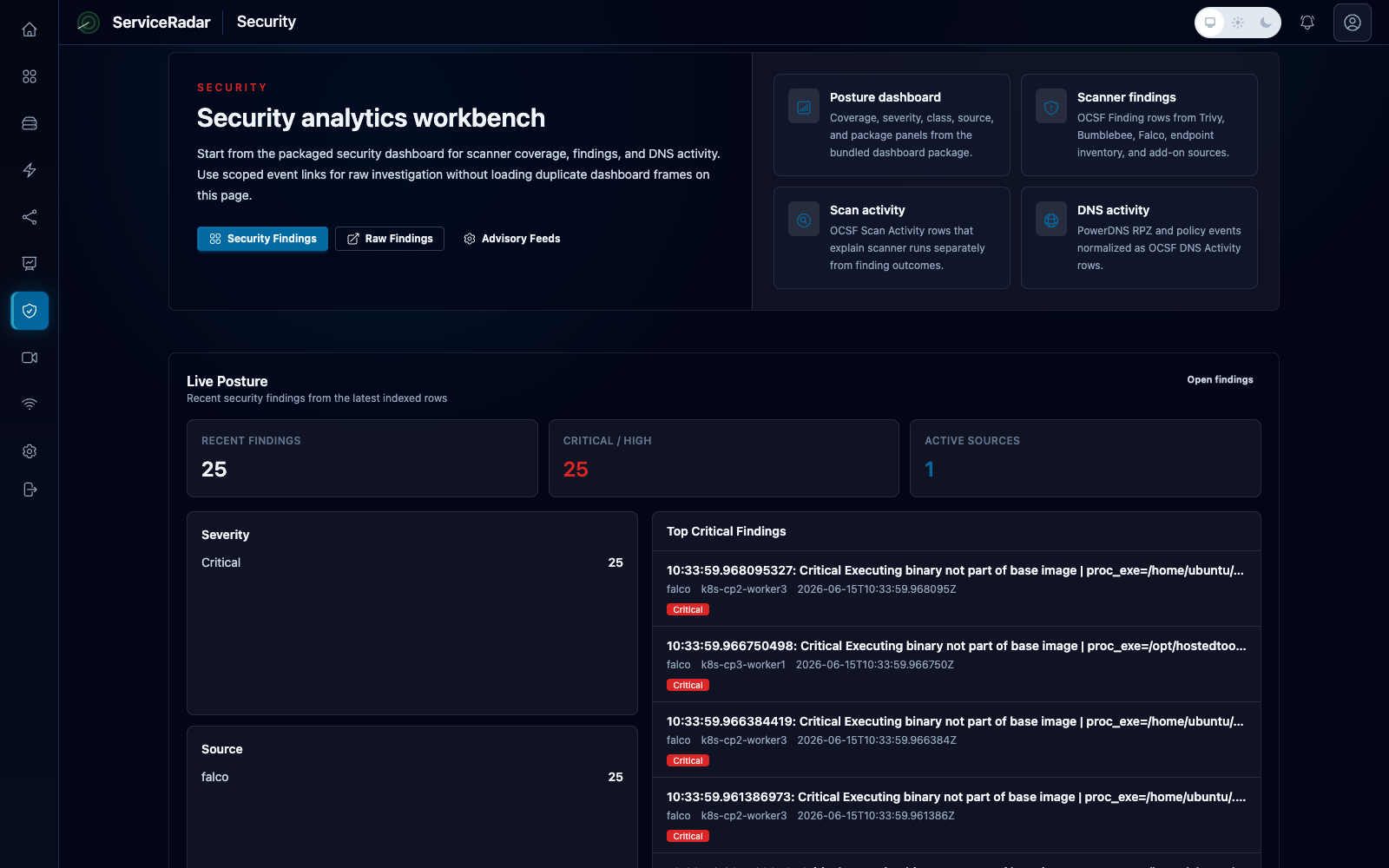
Installed software is matched centrally against NVD, CISA KEV, and VulnCheck. Flows are checked against AlienVault OTX indicators. PowerDNS RPZ hits, Falco, and Trivy findings arrive as OCSF events you can query with SRQL.

Threat intelligence and software risk
ServiceRadar security analytics workbench
Coming soon

Camera management without the per-camera license

Any IP camera runs through sandboxed plugins, with first-party integrations for UniFi Protect, Axis, and generic RTSP, and no inbound path into your network. Coming next: continuous recording to S3-compatible object storage or your own disks, segmented playback straight from S3, evidence holds and exports, and real-time AI object detection delivered to live viewers.

Camera and WiFi field operations
Typical commercial VMS
Per-camera device licenses, an annual care plan to keep them current, and storage tied to appliance hardware.
ServiceRadar
Open-source core, cameras on the same agent and inventory as the network, recordings on object storage you already own, and retention you set.

Custom dashboards, in the product or from your repo

Build panels in the product from SRQL queries, or ship a signed React package built with the Dashboard SDK. ServiceRadar provides the host shell, SRQL execution, Arrow-backed data frames, theming, and Mapbox and deck.gl maps, so a package only has to render the view.

Dashboard SDK and custom dashboards
$ npm create @carverauto/dashboard@latest \
    my-dashboard -- --template react-map
$ npm run dev        # HMR harness
$ npm run validate   # package contract
$ npx serviceradar-cli dashboard publish

Plugins that cannot touch the host

Custom checks and integrations compile to Wasm and run in a capability-based sandbox with no filesystem or raw socket access. Networking goes through an agent-side proxy with admin-approved allowlists, and every host call is logged. Write them in Go or Rust, sign them, and assign them to agents from the UI.

Investigate and interrogate it from an AI agent

ServiceRadar has a built-in MCP server. Connect Claude Code, Codex, Cursor, or Grok, sign in through your own SSO with OAuth and PKCE, and the agent runs SRQL queries and device lookups as your user, under the same RBAC as the UI. Automation uses client-credential tokens scoped to read and MCP, which SSO-mandated organizations can switch off. Access tokens expire after an hour.

MCP integration guide
$ claude mcp add --transport http --scope user \
    --client-id serviceradar-mcp \
    serviceradar https://<host>/mcp
$ claude mcp login serviceradar

Keep every flow, metric, and log as long as you want

ServiceRadar Cloud runs a StarRocks warehouse as the system of record for flows, metrics, logs, events, OTel traces, MTR, and BGP. Tables live in S3-compatible object storage and compute nodes cache the hot set, so storage grows without adding compute. Retention is per dataset, set in the UI. Self-hosted deployments run the same warehouse on local disks or S3.

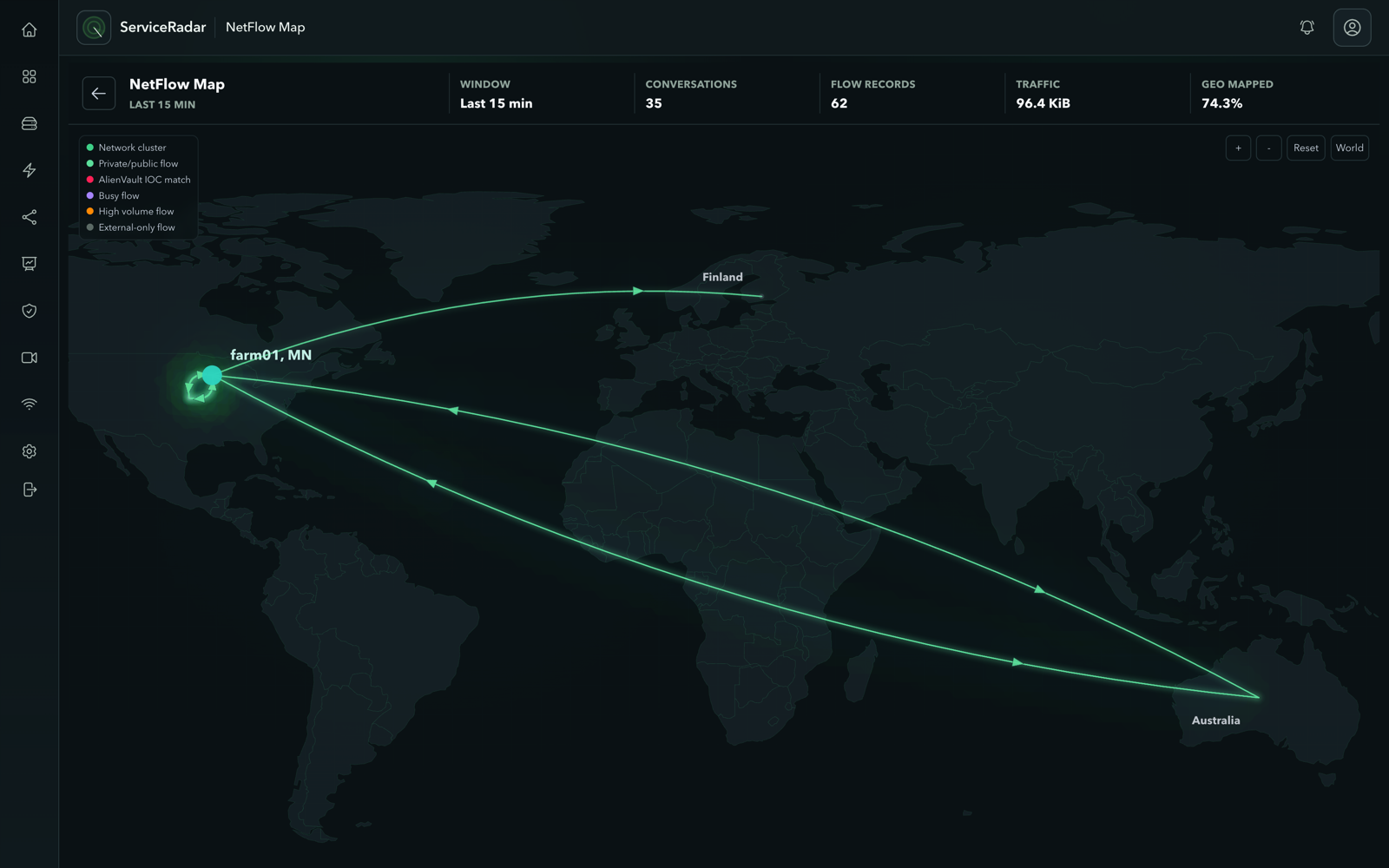
ServiceRadar NetFlow map of conversations across regions

Self-host the open-source platform today

ServiceRadar is Apache 2.0 licensed. Bring it up with Docker Compose in a few minutes or run the Helm chart on Kubernetes. Build images, plugins, and add-ons are signed, and an SBOM ships with every build.

Hosted ServiceRadar Cloud, powered by Horizon

Standard and Enterprise run managed web access, agent connectivity, dashboards, and backups on serviceradar.cloud—with ServiceRadar Horizon active for global Internet Weather, BGP/RPKI routing intelligence, and inside+outside correlation. Pricing and tenant accounts live on the control plane at control.serviceradar.cloud.

Standard

Core hosted operations

Hosted web access, secure agent connectivity, OTLP intake, dashboards, backups, and day-to-day operational workflows. Dedicated high-volume collector ingress and Enterprise SSO are not included.

Enterprise

Premium telemetry ingress + ServiceRadar Horizon

Automatically includes ServiceRadar Horizon for global Internet Weather, BGP routing intelligence, multipath path visibility, and automated inside+outside outage suppression—alongside Enterprise SSO, premium high-volume ingress for direct syslog, SNMP traps, NetFlow, sFlow, and BMP collectors, and everything in Standard.

Standalone Horizon access

Need global Internet Intelligence without a full ServiceRadar deployment? Consume ServiceRadar Horizon via our standalone API (JSON, GeoJSON, and signed webhooks) and read-only MCP server for platform teams and SRE workflows.

Explore Horizon
Book a discovery call Cloud signup coming soon

Use the control plane at control.serviceradar.cloud for pricing and tenant accounts, or book a discovery call to onboard Enterprise Cloud and ServiceRadar Horizon.

Platform partners

ServiceRadar integrates with the platforms operations teams already run.

ServiceNow
AWS
Microsoft
OpenText
Red Hat
Cisco
HPE

See it running on a real network

Walk through the live demo, or book a discovery call to talk through self-hosting, sizing, and ServiceRadar Cloud with Horizon.